Corals. They look like plants, but are in fact tiny invertebrates (spineless animals) belonging to the group of animals called Cnidaria. This makes them relatives of anemones and sea jellies.
Also called the forests of the sea, they help to create reefs that house some of the greatest biodiversity on earth. So much so that even though coral reefs cover less than 1% of the ocean floor, they support about 25% of all marine life.
Here are more facts about these amazing creatures:
1. There are hard corals and soft corals
Corals are generally classified as hard or soft. Hard corals are also called stony corals or reef-building corals due to their hard, calcium-based skeletons which form the bulk of a coral reef’s structure.

On the other hand, soft corals contain minute, spiny skeletal elements called sclerites that provide some degree of support and give their flesh a spiky, grainy texture that deters predators.

Read more about the differences between hard and soft corals
2. Reproduces asexually or sexually
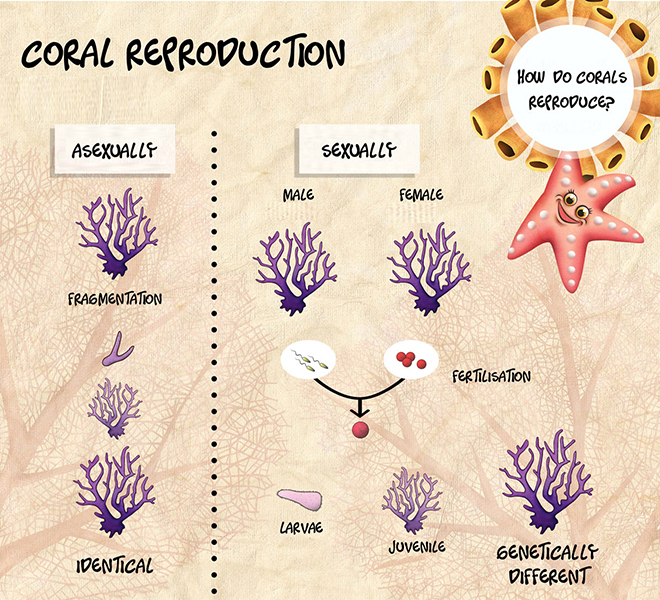
Corals such as the sun coral have the amazing ability to reproduce asexually (by fragmentation where an entire colony branches off to form a new colony). Whereas corals like the brain coral reproduce sexually (where eggs are fertilised by sperms).
3. Capture vs photosynthesis
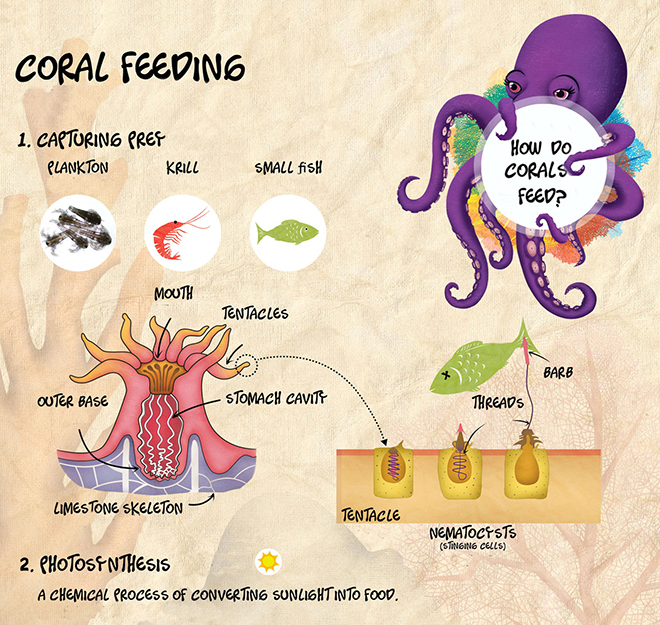
Being carnivores, corals feed on plankton, krill and small fish. But many corals also contain photosynthetic algae that live in their tissues. These algae produce oxygen, remove wastes, and supply the organic products of photosynthesis that corals need to thrive.
4. Colour algae-rithm
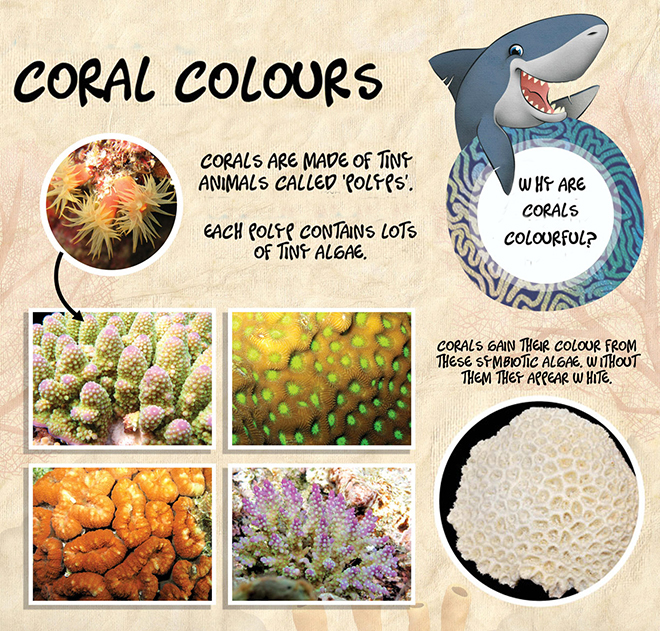
Speaking of algae, do you know that tiny, colourful marine algae called Zooxanthellae is also responsible for the corals’ mindboggling array of colours? Without them, corals would appear white.
5. Corals are threatened by climate change
Coral bleaching (corals turning white or very pale) is the result of the symbiotic Zooxanthellae being expelled due to stressors like pollution, excessive sunlight or unusually high water temperatures.

In 2017, the word’s largest living structure, Australia’s Great Barrier Reef, suffered massive coral bleaching – an unprecedented second year in a row. This marine system half the size of France has suffered four major bleaching events in less than 20 years, namely in 1998, 2002, 2016, and 2017.
Read more about coral bleaching
6. Corals glow
Corals are one of the many animals in our ocean that exhibit biofluorescence – a phenomenon where the animal absorbs a high-energy light such as violet or blue light, and gives off a lower-energy light such as green or red light due to loss of heat energy.
Corals glow for 2 main reasons: to protect their symbiotic zooxanthellae and to attract prey.

Read more about why corals glow
Here at S.E.A. Aquarium, we have a number of coral habitats which include numerous reef building stony corals and a colourful collection of soft corals. One of the most beautiful corals here is the Sun Coral which, surprisingly, do not require light to grow. You can read about our aquarist’s experience of caring for Sun Corals

Here’s a video of our popular Hard Coral habitat:
Come check out these beautiful corals at S.E.A. Aquarium soon!
Read more about corals: