If there was a prize for the Most Misunderstood Creature, it would go to the shark.
Sadly, sharks have an undeservedly bad reputation, thanks largely to the sensational stories we see in the media. You could be forgiven for thinking that man-eating sharks are out there, just waiting for you to venture into the water.
In reality, less than 10 people every year die from shark attacks. Compare this to more than 600,000 people who die every year from Malaria because of a mosquito bite, and you’ll see that you can’t judge how dangerous an animal is from its size or the amount of teeth it has.
During the SEAA Wonders: Sharks Month at S.E.A. Aquarium in August, our aim is to educate our guests, and help dispel the myths surrounding these beautiful but misunderstood creatures.
Frequently Asked Questions (FAQ) about sharks
Here are a few of the actual questions our guests have asked us during Shark Month.
Q: Are all sharks man-eaters?
Sharks eat fish or marine invertebrates that they find in their environment, and humans do not feature in their natural diet. The majority of incidents involving humans and sharks are cases of misidentification; sharks may mistake a human swimmer or diver for a similar sized or shaped prey.
Interestingly, some of the larger species of shark with the biggest mouths, like Whale Sharks and Basking Sharks, actually eat some of the smallest animals in the ocean. To do this, they swim forward with their mouths wide open, using their ‘gill rakers’ to strain plankton and tiny crustaceans from the water.
Q: Is it true that sharks need to keep on swimming to stay alive?
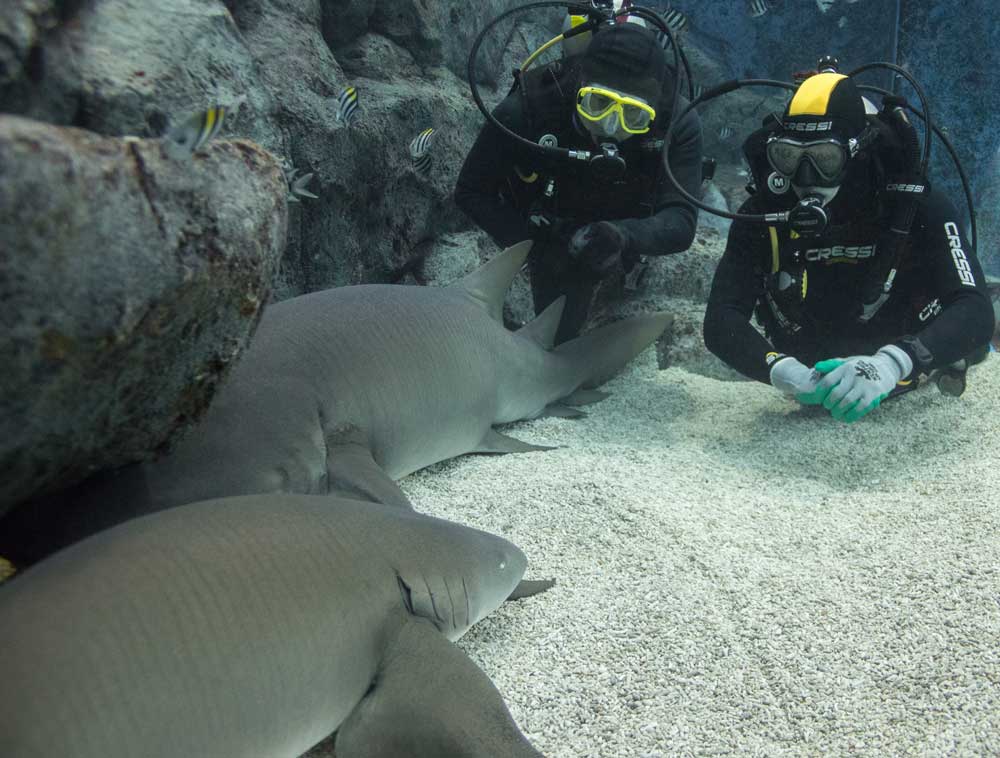
The idea that sharks will drown if they stop swimming is a common one, but it’s not entirely true.
Like us, sharks need oxygen to live, and they absorb it from the water that passes over their gills. Some sharks keep the water flowing by swimming around, or by positioning themselves in a strong current. This is called ‘ram ventilation’.
Other sharks prefer to lie on the seafloor, or tuck themselves into crevices for protection. They use their jaws to move water through their gills, and this is called ‘buccal pumping’. Our Tawny Nurse Sharks and Zebra Sharks are prime examples of sharks that use this method of breathing.
Q: If a shark loses a fin, can it grow a new one?
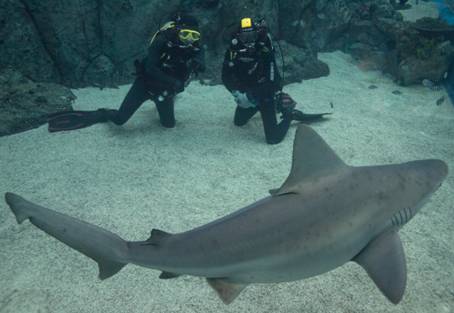
Some marine animals do have regenerative powers, like sea stars that can lose their arms and grow new ones, or sponges that can be damaged but then reform themselves.
Unfortunately, this is not the case with sharks. Fishermen who catch sharks, cut off their fins, and throw them back in the water are simply leaving them to die a slow, painful death.
What’s more, since a dorsal fin accounts for only 3% of the shark’s total weight, this means they are discarding 97% of its body, which makes little economic sense.
Q: Does shark fin soup really have medicinal value?
Shark fin soup is a popular dish in Chinese culture. It has long been believed that shark fins have medicinal value, and serving it to your guests can give an indication of your class or wealth.
However, they have been found to contain an alarming concentration of toxins, and recent research suggests that consumption of shark fins increases the risk contracting a number of degenerative diseases.
Q: How many sharks are there in the world’s oceans?
It’s difficult to put a number on it, be we do know that the world’s shark population has decreased by more than 90% over the last 50 years.
Sharks are slow-growing and late to mature, making them vulnerable to overfishing if they are caught at a rate faster than they can reproduce.
We can take the first step in restoring the balance in the marine ecosystem by choosing not to eat shark fin soup.