It has an eel-like body, Angelina Jolie’s lips, and a monkey-ish face with what looks like a nasty fungal condition.

Meet the Japanese Warbonnet (Chirolophis japonicus), a bizarre-looking fish that is as cryptic as it looks. Growing up to about 55cm long, it belongs to a large species of blennies found in the shallow, temperate rocky reefs off Japan.
Different names, same fish
The Japanese Warbonnet (also called the Fringed Blenny) got its name from the fascinating mass of cirri (mini tentacles) that sprout out of its head, resembling the feathers on an Indian Chief’s war bonnet. The cirri also makes its head look like a pile of sea anemones and hydroids – possibly a camouflage strategy.
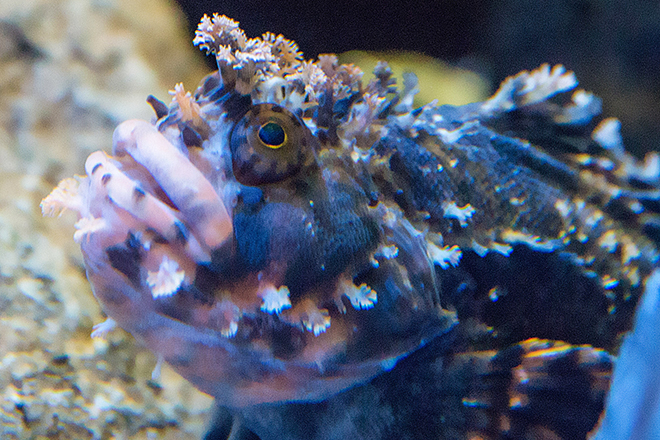
It is also commonly known as the Monkey Faced Blenny due to its resemblance to the primate.
They are a benthic species
Japanese Warbonnets are typically found in the benthic zone – the ecological region at the lowest level of a body of water (in this case the ocean). They usually live in rock crevices or the sea bed, feeding on bottom invertebrates like small mollusks, crustaceans and polychaetes.
They spawn in winter
According to studies, Japanese Warbonnets attain sexual maturity when they reach a total length of 25cm (males) and 30cm (females) .In Mutsu Bay in Japan, it is observed that their spawning period lasts from late November to December, when the water temperature falls below 10°C.

They display dominance
Edmund Verghese, the aquarist taking care of our two Japanese Warbonnets at S.E.A. Aquarium, noticed a ‘hierarchy’ between the fish residing within the same habitat.

Edmund: “They are about the same size but for some reason, the one living in the higher crevice appears to be the dominant Warbonnet. During feeding time, it always grabs the first piece of cut prawn or fish. Only when it returns to its crevice to finish eating its food will the other Warbonnet in the lower crevice swim up to feed.”
“They usually keep their body hidden in the crevice with just their head peeking out. But we have also observed them chasing each other around the habitat.”

| Come see the Japanese Warbonnets at the Nautilus habitat, right beside the Giant Spider Crab habitat. If you’re lucky, you might just see them chase each other around. | ||||||
|
||||||
CURIOUS ABOUT WHAT ELSE IS IN THE AQUARIUM? |
||||||
|
||||||