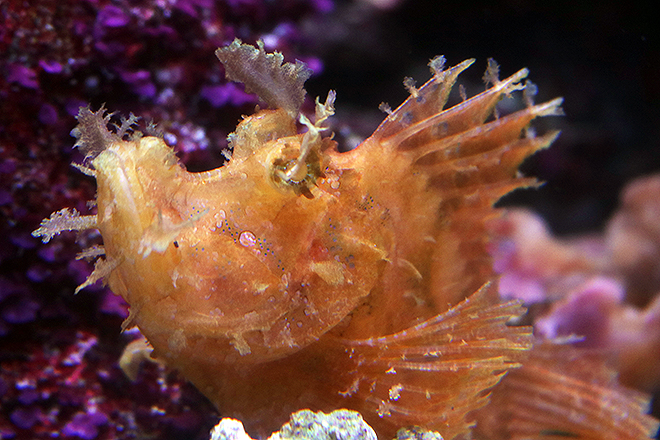
Their name comes from the excruciating pain they inflict using venomous spines on their dorsal, anal and pelvic fins. That said, Scorpionfish (Scorpaenidae) are not usually aggressive and prefer to hide or swim away, using their venom as the last resort to deter potential predators.

When they do sting, it can be potentially fatal to animals and extremely painful to humans. As such, Scorpionfish, even dead ones, should not be handled.
Masters of disguise
These bottom-dwellers are covered in feathery fins or skin flaps, as well as mottled patterns in colours ranging from dull brown to bright red. All these make them virtually invisible among the rocks and corals. So much so that their prey often never see what’s coming until it’s too late.

Sit-and-wait predators
Scorpionfish are nocturnal hunters that spend their daylight hours resting in crevices. These exceptional ambush predators remain in the shadows of rocks or reefs before pouncing on unsuspecting prey like small fish and crustaceans. Using their large mouth to create a vacuum, they suck the prey in and swallow it whole – in a matter of mili-seconds.
Here’s a clip of a Scorpionfish swallowing a baby Boxfish, only to spit it out right after – the Boxfish’s toxic secretion proved unsavoury for its predator and in turn saved its life.
Scorpionfish have few predators thanks to their venomous spines. But sharks, rays and large snappers have been known to hunt them.
Transparent eggs
Scorpionfish are oviparous with females producing eggs that are transparent or greenish. During spawning, thousands of eggs and sperms are released, resulting in a floating gelatinous mass on the water surface in which the fertilised eggs are embedded.

Upon hatching, the baby Scorpionfish will remain near the surface until they are big enough to swim down to the reefs where the adults reside.