Like all sea jellies, White Spotted Sea Jellies are living fossils which have existed for at least 500 million years. Amazingly, they have barely changed in all that time. Check out what else make these sea creatures so fascinating.
1. No brains
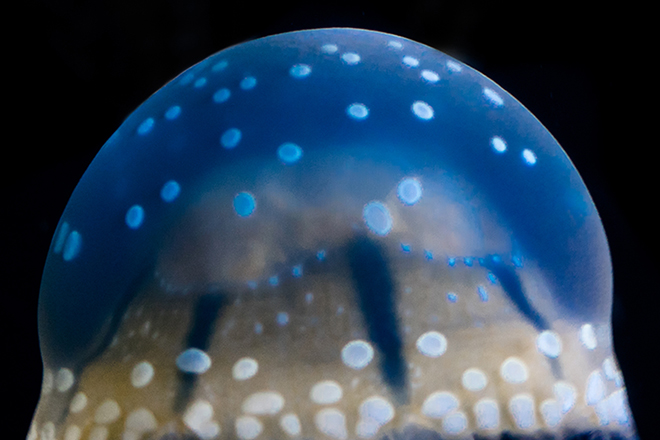
Sea jellies do not have a brain as we know it. Instead, these ocean drifters have a ring of nerves called a nerve net, which transmits information about its surroundings throughout their body.
2. More than 90% water
Over 90% of their body is water, together with a gelatinous substance that gives them structure.
3. Mouths on their arms
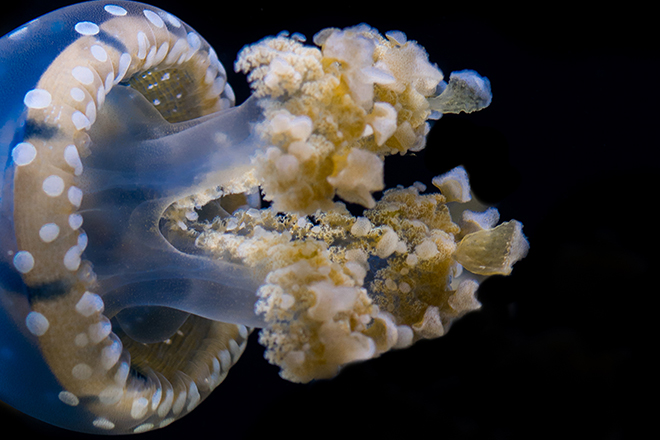
Each White Spotted Sea Jelly has four clumps of oral arms with downward hanging appendages. On each arm are many small mouth openings that capture zooplankton as they filter the sea water. Each White Spotted Sea Jelly can filter more than 50 cubic meters of seawater every day.
4. Grow their own food
Apart from filter feeding, White Spotted Sea Jellies also grow symbiotic algae in its tissues. These algae give the Jellies a greenish-brown colour and produces food through photosynthesis for them to harvest.
5. Venomous but not deadly
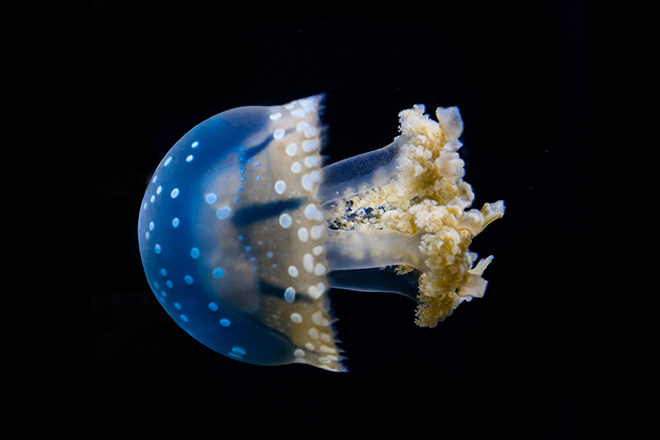
Being largely filter feeders, White Spotted Sea Jellies do not generally use their venom to capture prey. Their venom is very mild and do not pose a threat to human beings.
6. Invasive, voracious predators
Because White Spotted Sea Jellies often travel in large swarms, they can disrupt an area’s ecosystem by consuming large amounts of plankton. This leads to food shortage for other marine animals that feed on plankton, such as fish and crustaceans.
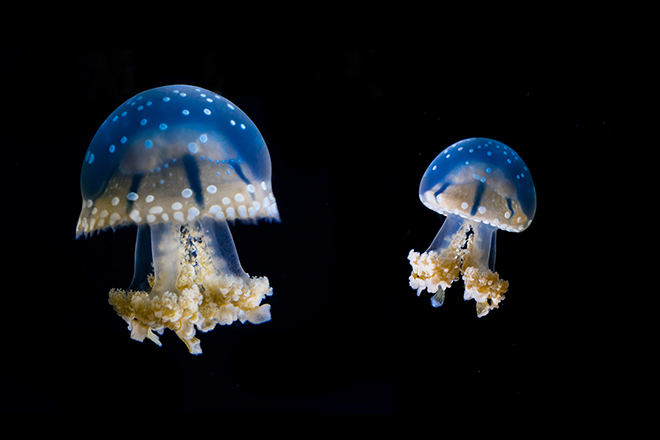
Come see the White Spotted Sea Jellies at the Sea Jelly Habitat, located just shortly after the Open Ocean Habitat.
All images above are taken by Boon Ping, aquarist at S.E.A. Aquarium